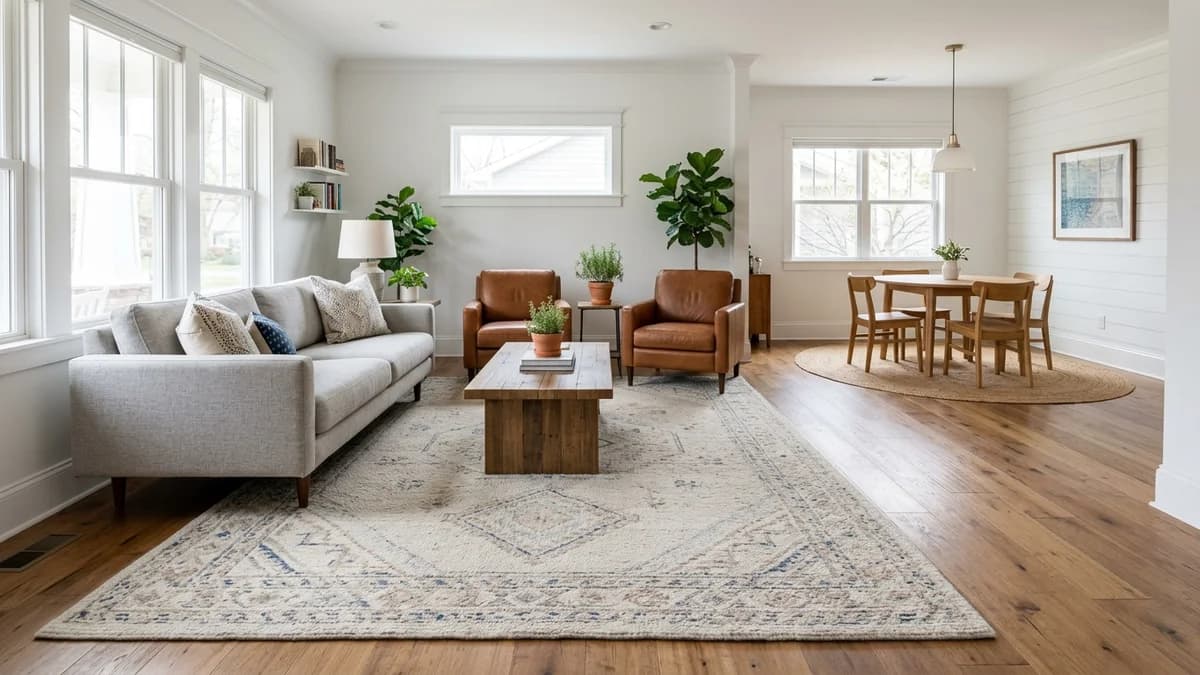
Open floor plans are fantastic for creating a sense of space and light, but they come with a unique design challenge: how do you create distinct, cozy, functional areas without walls? The answer is often right under your feet. A well-chosen rug does more than just add color; it acts as an 'invisible wall,' anchoring furniture and creating clear zones for living, dining, and relaxing.
Think of this guide as your friendly blueprint for getting it right. We'll walk you through how to use rugs to perfectly define and ground each part of your open-concept space, making it feel both cohesive and intentionally, beautifully designed.
Why Rugs Are Your Secret Weapon in an Open Floor Plan
In a traditional room, walls do the heavy lifting. In an open concept, that job falls to your furnishings—and most importantly, your rugs. They create the visual boundaries that tell your brain, "This is the living area," and "Over here is where we eat."
Without a rug to ground it, a sofa and chair set can look like it's just floating aimlessly in a sea of flooring. By placing a rug, you create an island of purpose. It visually pulls the furniture together into a cohesive group, making it feel settled and intentional. This is especially crucial in large, echo-prone rooms, where rugs also work wonders to absorb sound, add welcome texture, and inject a dose of color and personality.
The key insight? A rug in an open plan isn't just decoration. It acts as an 'architectural suggestion,' subtly guiding foot traffic and how you see the space without a single physical wall.
Step 1: Map Your Zones Before You Measure
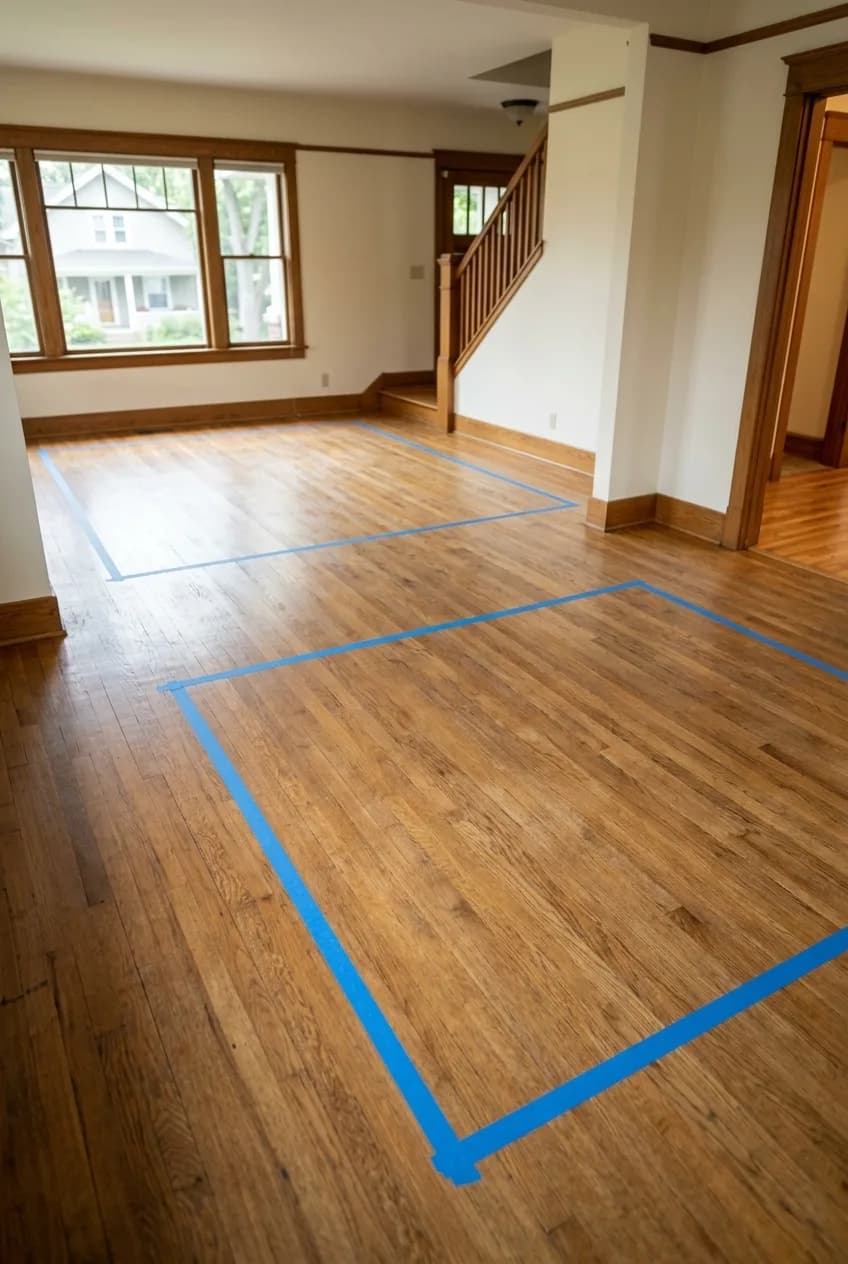
Before you even think about shopping, grab a roll of painter's tape. First, stand in your space and identify its primary jobs: a living zone, a dining spot, and maybe a reading nook. Don't forget to consider the walkways that connect them.
Now, arrange your furniture how you want it, and use the painter's tape to outline the ideal rug placement for each zone directly on the floor. This simple trick is a game-changer. It takes all the guesswork out of measuring by forcing you to see the real-world scale and how the different areas will interact.
As you lay down your tape, be mindful of traffic flow. You need to leave clear, generous pathways between zones for people to walk without having to step on the edge of a rug.
This is a crucial detail: the empty space *between* your rugs is just as important as the rugs themselves. These 'negative spaces' become the natural, defined walkways of your open-concept room, so give them room to breathe.
Sizing the Living Area Rug: Anchoring Your Main Zone
The living area is typically the largest zone and its rug is the foundation of your open-plan design. Getting this size right is crucial. There are two main rules to follow, with one being the clear winner for this type of space.
The Minimum: The 'Front Legs On' Rule
This is the baseline standard for any living room. The rug should be large enough so that at least the front two legs of your sofa and any chairs in the grouping are sitting on it. This physically connects the pieces and prevents the dreaded 'floating rug' syndrome, where a too-small rug sits isolated in the middle of the furniture. It's an acceptable solution, but in a vast open plan, it can sometimes feel a bit sparse.
The Ideal: The 'All Legs On' Rule
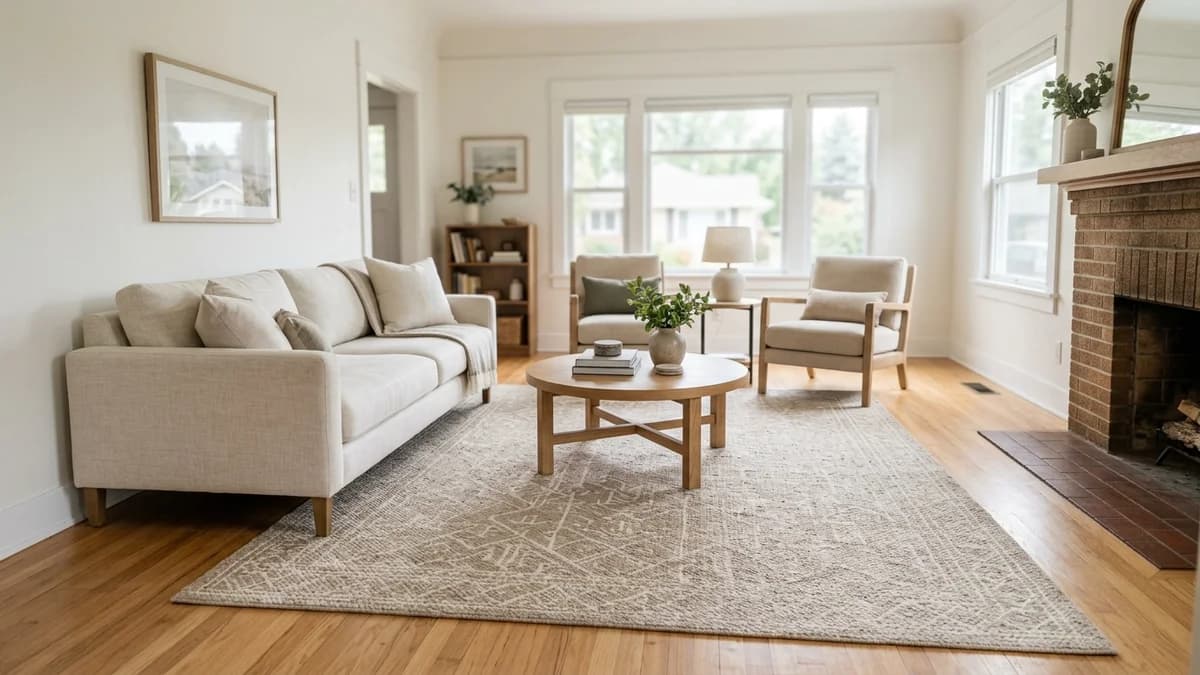
For an open floor plan, the 'All Legs On' rule is almost always superior. Here, the rug is generous enough to fit all of your furniture—sofa, armchairs, side tables, coffee table—completely on top of it, with some room to spare. Why is this better? Because it more decisively and luxuriously establishes the zone's boundary against the rest of the open space. It creates a truly defined, room-like feel that’s both visually grounding and comfortable underfoot.
Quick Sizing Reference
While you should always measure your own space with the tape method, these standard sizes are excellent starting points for common furniture arrangements.
Furniture Grouping | Typical Rug Size | Goal |
|---|---|---|
Standard Sofa, 2 Armchairs, Coffee Table | 8' x 10' | Achieves the 'Front Legs On' rule comfortably. Can sometimes accommodate 'All Legs On' in a more compact arrangement. |
Large Sofa/Small Sectional, 2 Armchairs, Coffee Table | 9' x 12' | The go-to size for achieving the ideal 'All Legs On' rule, creating a clearly defined and generous living zone. |
Large Sectional, Coffee Table, Side Chair | 10' x 14' or larger | Necessary for oversized sectionals to ensure the rug feels proportional and can fully anchor the entire seating area. |
More in Home Decor
Area Rug vs. Wall-to-Wall Carpet: The Best Choice for a Small Living Room
Perfecting the Dining Area Rug: Form Meets Function
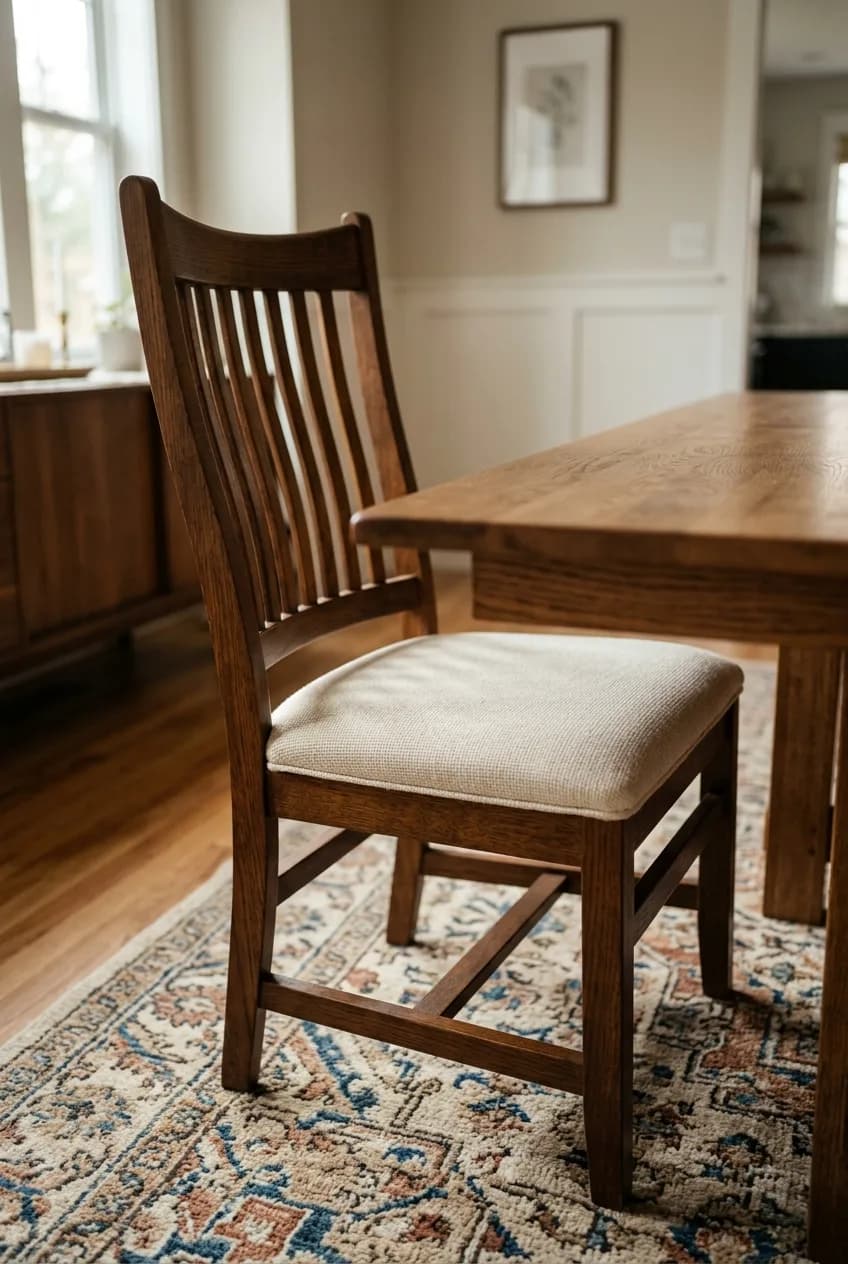
The dining area rug has one job that’s even more important than looking good: it has to be functional. The number one rule here is what we call the 'Chair Pull-Out' rule.
Your rug must be large enough to extend at least 24 inches beyond the edge of your dining table on all sides. Why 24 inches specifically? This is the space someone needs to comfortably slide their chair back to stand up without the chair legs catching on the edge of the rug. A dining rug that's too small is a functional hazard, not just an aesthetic one. That constant snagging of chair legs is a daily annoyance you can easily design around from the start.
For visual harmony, try to match the shape of the rug to the shape of your table. A rectangular table looks best over a rectangular rug, and a round table is a perfect match for a round or square rug. When it comes to materials, think practical. Low-pile materials like wool, polypropylene, or other synthetics are your friends here. They are easier to clean and allow chairs to slide smoothly, unlike a high-pile shag rug which would be a nightmare for crumbs and movement.
Coordinating Multiple Rugs Without Chaos
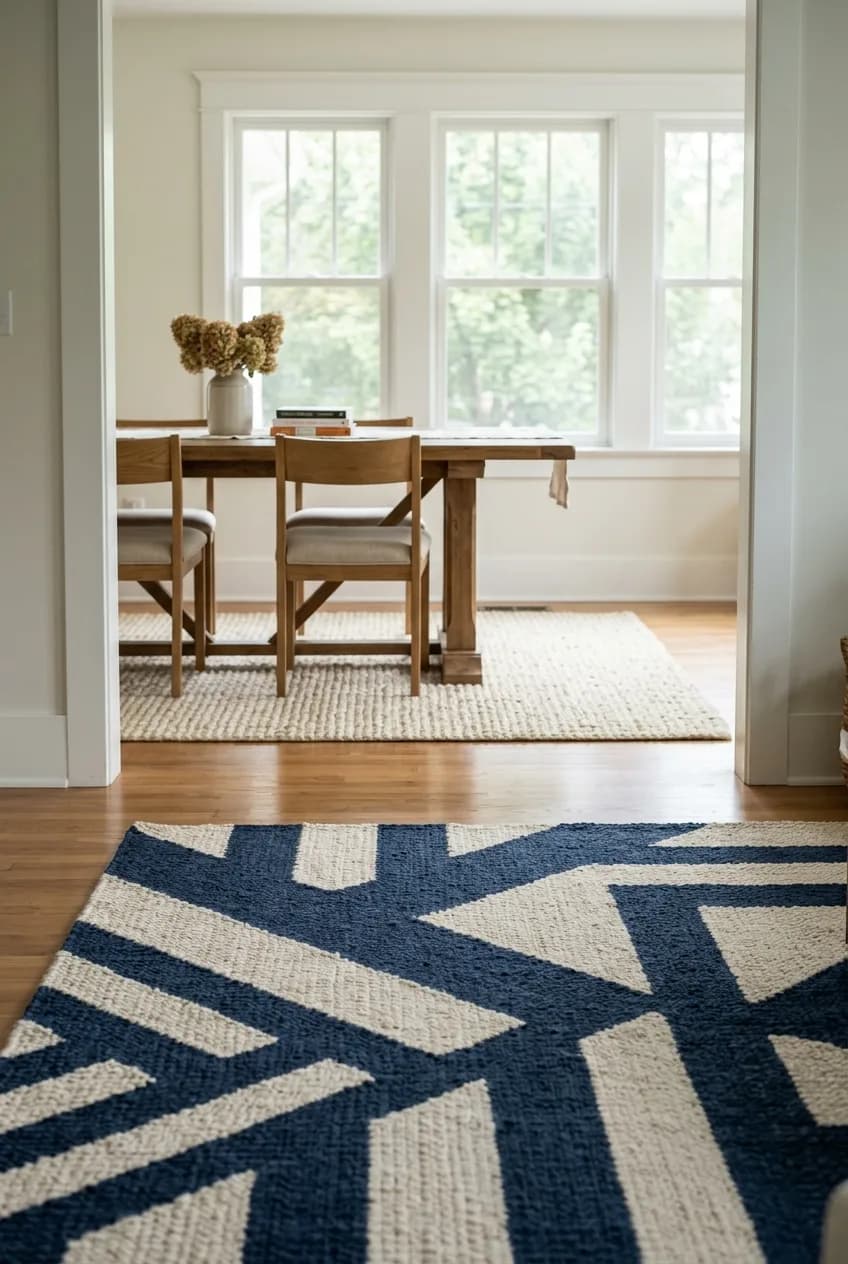
So, how do you use multiple rugs in one large space without it looking like a chaotic patchwork? The goal is coordination, not perfect matching. Think of your rugs as a 'family,' not 'twins.' They shouldn't be identical, but they should share a clear common trait that proves they belong together in the same home.
Establish a Shared Color Palette
This is the easiest and most effective method. Choose a core palette of three to five colors and make sure each rug features at least two or three of them. For example, your living room rug could have a navy blue background with cream and gray accents, while your dining room rug could be a simple gray and cream stripe. They are different, but the shared colors tie them together.
Vary Pattern and Scale
If you love patterns, you can absolutely use more than one, but the key is to vary the scale. If your living area rug has a large, bold, graphic pattern, pair it with a rug in the dining area that has a much smaller, more subtle pattern, or even a solid color with rich texture. Two large, loud patterns will visually compete with each other and make the space feel busy.
Play with Complementary Textures
For a more neutral, serene look, you can create distinction and interest through texture alone. Imagine pairing a soft, plush wool rug in the living area with a flatweave jute or sisal rug under the dining table. They both might be a similar shade of beige, but their different textures create distinct zones while maintaining an overall calm and cohesive feel.
Common Rug Sizing Mistakes to Avoid
Navigating rug sizes can be tricky, but avoiding these common pitfalls will put you on the right track. The single most common and correctable mistake is buying a rug that is too small to save money. A rug that is slightly too big is always a better design choice than one that is slightly too small.
- The 'Floating Rug': This is that small 5x7 rug adrift in the middle of a large seating area, touching no furniture. It visually shrinks the space and makes the furniture arrangement feel disconnected and awkward.
- Blocking Pathways: A beautiful rug won't feel right if its edge creates a tripping hazard or forces an awkward detour through a main traffic lane. Always prioritize clear, wide walkways between your defined zones.
- Ignoring Proportions: This happens when the rug is technically touching the furniture (meeting the 'front legs on' rule), but it's still so small relative to the furniture that it looks like a postage stamp. An undersized rug makes your furniture look oversized and the whole zone feel cramped.